The landscape of management systems is undergoing a profound transformation. With the recent release and implementation of ISO 14001:2026, organizations are increasingly focused on how their auditing practices must evolve to maintain credibility and global relevance.
At the center of this evolution is ISO 19011, “Guidelines for auditing management systems.”
ISO 19011 is the definitive framework for any organization performing internal or external audits. It provides the standards for audit principles, program management, and the evaluation of auditor competence.
In an industry where “not everyone with a certificate is a professional,” ISO 19011 serves as the benchmark to ensure that audits provide genuine value, mitigate risks, and support career growth in compliance and quality.
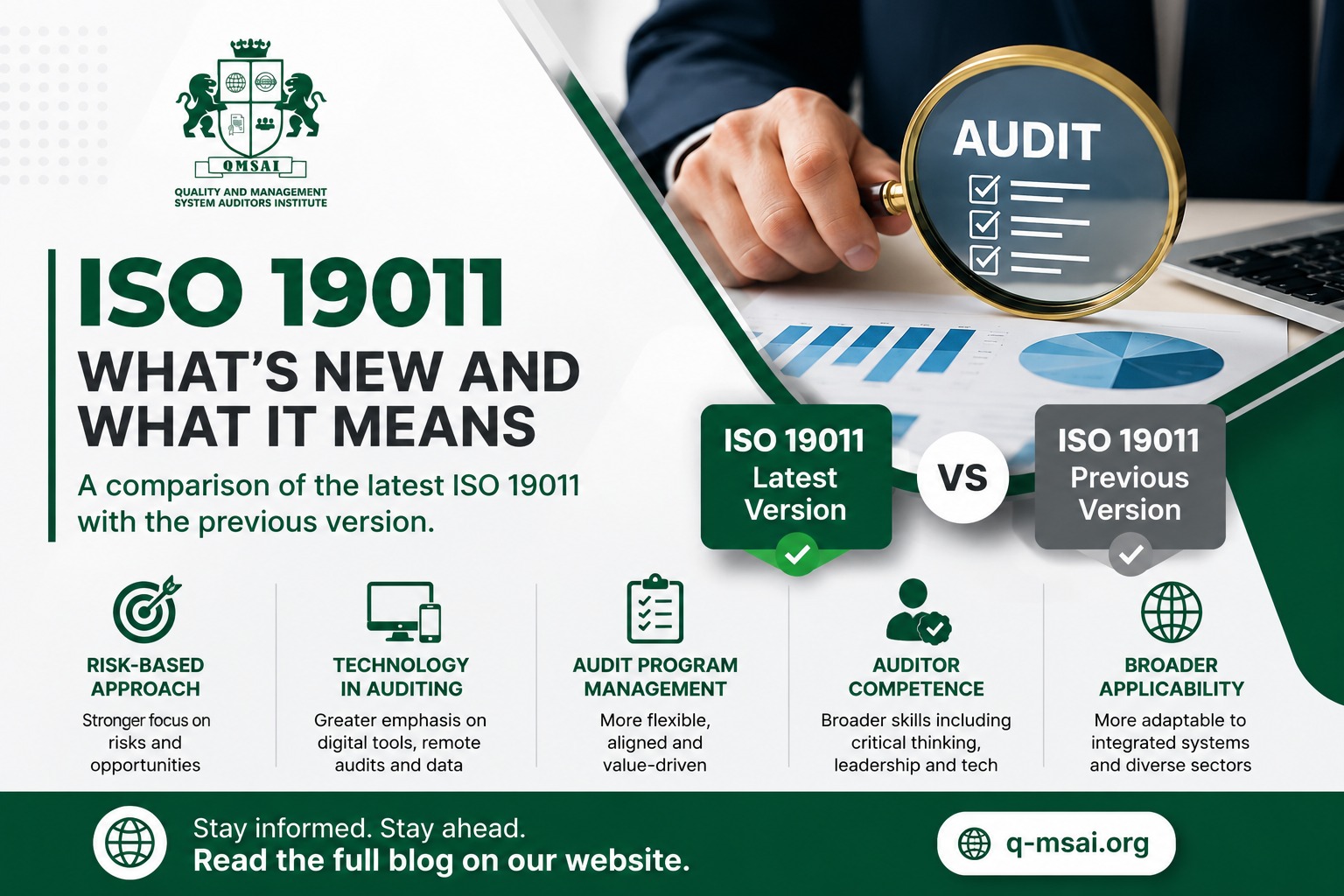
This post explores the critical transition from the previous ISO 19011:2018 guidelines to the latest 2026 version, highlighting how modern auditing has shifted from a process-heavy activity to a strategic, risk-informed discipline.
Key Changes: 2018 vs. 2026
1. Key Principles of Auditing
The 2018 version of ISO 19011 established seven core principles, including integrity, confidentiality, and the risk-based approach. The 2026 version reinforces these by placing a heightened emphasis on professional judgment and the evidence-based approach.
While the 2018 version introduced risk-based thinking, the latest guidelines move beyond mere identification of risks to the actual evaluation of professional judgment as a core competency. Auditors are now expected to demonstrate mastery of “Advanced ISO 19011” concepts, ensuring that conclusions are not only supported by data but are also contextually relevant to the organization’s strategic objectives.
2. The Expansion of the Risk-Based Approach
Under ISO 19011:2018, the risk-based approach focused largely on the risks to the audit process itself (e.g., sampling errors or resource shortages). In the 2026 landscape, the risk-based approach has become much more granular and integrated.
Organizations are now required to maintain comprehensive Risk Assessment Records that identify specific threats to the audit scheme’s integrity. Current data shows that risks such as “inaccurate evaluation of candidate competence” and “inconsistent application of requirements” are now categorized as high-level risks requiring standardized assessment criteria and constant calibration.
Furthermore, the scope of risk assessment has expanded to include impartiality risks, such as commercial pressures or prior consultancy relationships, which must be documented in formal registers to ensure objectivity.
3. Changes in Audit Program Management
Audit program management has evolved from a static schedule to a dynamic, continuous improvement process. The 2018 version focused on planning and resources, but the 2026 guidelines emphasize scheme review and maintenance.
Practical implementation now requires a Scheme Review and Maintenance Register, where findings from internal reviews, such as outdated assessor matrices or misaligned audit schedules, are documented and tracked through to completion.
This ensures that the audit program remains aligned with certification cycles and responds to organizational changes in real-time. Additionally, there is a clearer separation between training providers and certification bodies to prevent conflicts of interest and maintain high-quality training frameworks.
4. Auditor Competence: From Generic to Specialized
The 2018 version defined competence through general knowledge and skills. The 2026 version, however, demands sector-specific competence and digital proficiency.
A significant change is the introduction of mandatory Continual Professional Development (CPD) logs that specifically track hours in areas like “Risk-Based Thinking” and “Digital & Remote Auditing Techniques”. Auditors who fail to meet these requirements or who misrepresent their audit experience now face formal suspension.
Competence is no longer just about “attendance” at training; it is about “certifying competence” through multi-stage assessments, including oral interviews, written exams, and practical audit log verification.
5. The Integration of Technology in Auditing
While the 2018 version alluded to remote auditing, the 2026 version treats it as a primary modality requiring its own set of controls and competencies. The lack of digital auditing competence is now identified as a medium-level risk to audit effectiveness.
Modern guidelines require a formal Remote Assessment Protocol, which must include:
- Secure online platforms and VPN-only access,.
- Multi-factor authentication (MFA) and periodic access reviews.
- Strict candidate identity verification to prevent fraud.
- Encryption for confidential audit materials and data,.
Practical Implications for Organizations
The transition to these updated guidelines has immediate practical consequences for quality and compliance departments:
- Heightened Security Requirements: Organizations must mitigate the risk of “cybersecurity breaches of exam platforms” and “unauthorized access to confidential records”. This necessitates a shift toward centralized digital records systems with robust backup and access controls.
- Calibration and Consistency: To prevent “inconsistent assessment outcomes,” organizations must implement regular assessor calibration workshops. These workshops are critical for ensuring that all auditors interpret standards and scoring rubrics uniformly.
- Refined Communication and Transparency: There is a greater focus on standardizing communication formats to prevent “misinterpretation of certification decisions”. This includes the use of standardized decision letter templates and automated tracking systems for complaints and appeals.
- Stricter Ethical Oversight: Conflict-of-interest (COI) declarations are no longer optional “one-time” forms; they must be submitted annually and verified before every assignment to protect impartiality.
Actionable Insights and Recommendations
To align with the latest auditing standards, we recommend that organizations take the following steps:
- Update Your Personnel Competence Register: Ensure that your auditor matrices reflect current qualifications, including specific training on the ISO 14001:2026 transition and digital auditing techniques,.
- Formalize Remote Auditing Controls: If you utilize remote assessments, implement a secure VPN and mandatory MFA. Test your remote platform quarterly to ensure stability and data integrity.
- Implement a Robust CPD Monitoring System: Use a structured CPD Log to track auditor learning outcomes. Set a minimum requirement (e.g., 20+ hours) for reinstatement of any suspended certifications,.
- Strengthen Root Cause Analysis (RCA): When non-conformities are identified—such as delays in issuing results or missing documentation—use a formal RCA Record to identify causes and implement corrective actions through a Corrective Action Register (CAR),.
- Conduct Annual Impartiality Reviews: Perform a comprehensive risk assessment of all potential threats to impartiality, including revenue dependencies and personal relationships, and document these in an Impartiality Risk Register.
Conclusion
The evolution of ISO 19011 reflects a global commitment to higher standards of professional recognition and system excellence. By moving from the process-focused 2018 version to the risk-driven and technologically advanced 2026 framework, organizations can ensure their audits are not only compliant but also “globally relevant”.
Auditing is no longer just about checking boxes; it is about providing the strategic oversight necessary to navigate a complex, risk-filled corporate environment.
Embracing these changes today will protect your organization’s credibility and empower your professionals to lead with confidence in the years to come.