Today 16th September 2026, the International Organization for Standardization (ISO) officially published ISO 9001:2026 (6th Edition), replacing ISO 9001:2015 and its 2024 climate-change amendment, both of which are now formally withdrawn.
As the world’s most widely used quality management standard, with over one million certified organizations across 189 countries—this publication marks a pivotal moment for quality management professionals, auditors, and executive leaders. The release of ISO 9001:2026 provides an opportunity to modernize quality management systems (QMS), align operational processes with high-level strategic direction, and strengthen quality culture across organizations.
What Is ISO 9001:2026?
ISO 9001:2026 is the latest international standard specifying requirements for a Quality Management System. Developed by Technical Committee ISO/TC 176/SC 2, the 36-page document establishes a framework for organizations of any size or sector to consistently deliver conforming products and services, enhance customer satisfaction, and drive continuous performance improvement.
Why Was ISO 9001 Revised?
ISO periodically reviews its standards to ensure they remain relevant in a rapidly changing global economy. Following a comprehensive global consultation in 2023, consensus was reached among national standards bodies that ISO 9001 should be updated to address evolving business environments, technological shifts, and complex supply chain dynamics.
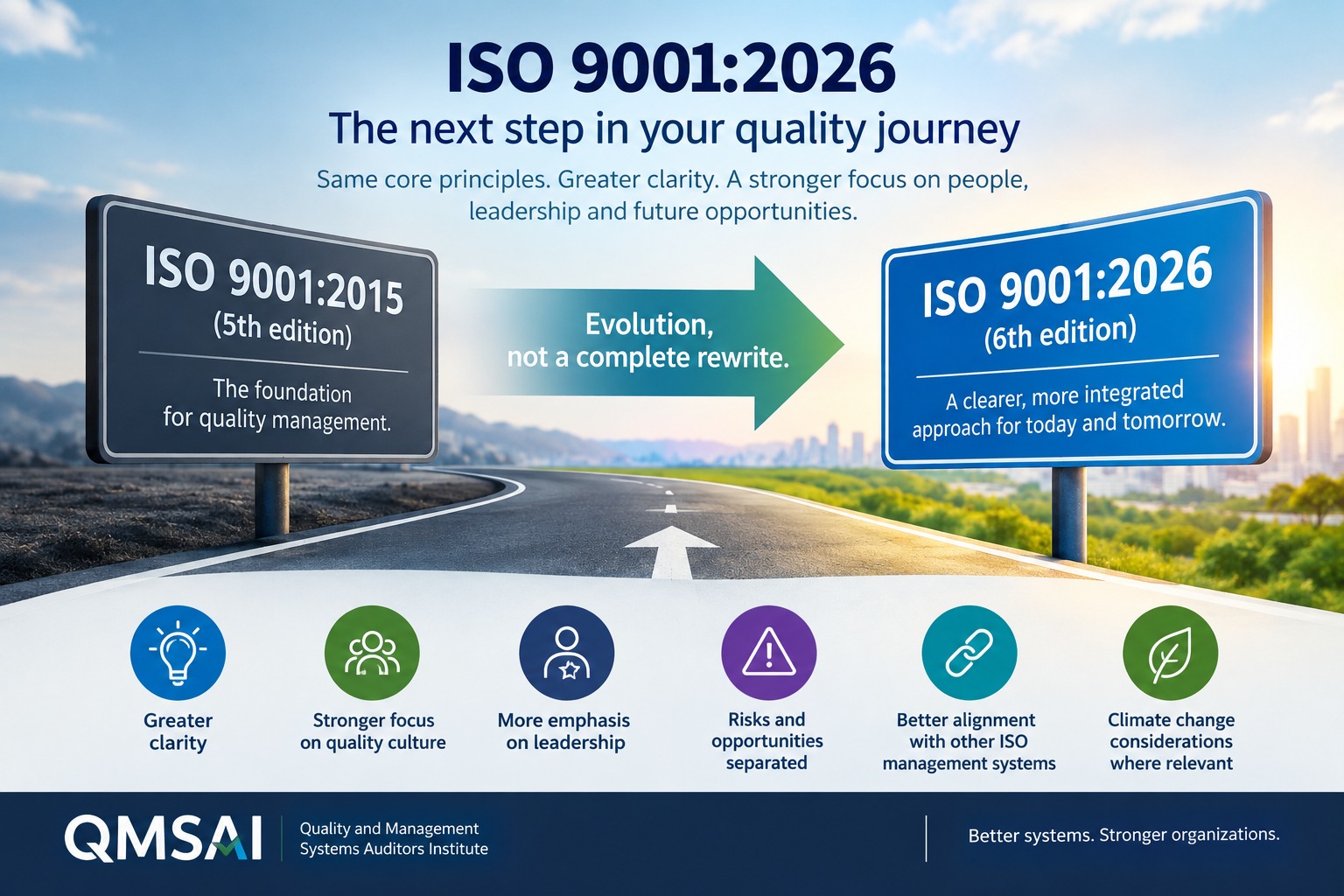
The 2026 edition is an evolutionary update designed to enhance clarity and user value, rather than a radical teardown of foundational quality management principles.
What Has Changed in ISO 9001:2026?
While preserving core QMS concepts, such as the Plan-Do-Check-Act (PDCA) cycle, the process approach, and the seven quality management principles—ISO highlights several key updates in the 2026 edition:
• Improved Clarity across Organization Types: Language has been refined so organizations of varying maturity levels, sizes, and operational structures can understand and apply requirements without confusion.
• Greater Emphasis on Quality Culture: The standard explicitly highlights that quality is an organization-wide responsibility, moving away from the misconception that QMS compliance belongs solely to a quality department.
• Strengthened Leadership Engagement: Top management must integrate the QMS into strategic business planning and routine decision-making processes.
• Explicit Separation of Risks and Opportunities: ISO 9001:2026 clearly distinguishes between managing potential negative deviations (risks) and proactively pursuing beneficial outcomes (opportunities).
• Improved Harmonization with Other ISO Management System Standards: Enhanced structural alignment facilitates integration with standards such as ISO 14001 (Environmental), ISO 45001 (OH&S), ISO/IEC 27001 (Information Security), and ISO 50001 (Energy).
• Incorporation of Climate Considerations: Contextual considerations regarding climate change, initially introduced in the 2024 amendment, are now fully incorporated into the main framework of the standard.
What Does ISO 9001:2026 Mean for Currently Certified Organizations?
If your organization is currently certified to ISO 9001:2015, your certification remains active during the transition period. Certified entities will need to transition to the 2026 edition within the timeframe aligned with their certification cycle.
Because ISO develops standards but does not conduct audits or issue certificates directly, specific transition schedules, surveillance arrangements, and assessment timing must be confirmed with your accredited certification body.
Do You Need to Rebuild Your QMS from Scratch?
No. Organizations with an effective ISO 9001:2015 QMS do not need to discard existing processes or rebuild documentation from zero. The core operational framework remains intact. The transition requires a targeted evaluation to identify gaps, refine existing documentation where necessary, and ensure alignment with updated leadership, culture, and risk/opportunity requirements.
How to Prepare for the Transition: An 8-Step Roadmap
To navigate the transition systematically, QMSAI recommends the following practical roadmap:
- Obtain the Official ISO 9001:2026 Standard: Work directly from the published ISO text rather than unofficial online summaries.
- Educate Key Stakeholders: Ensure leadership, quality teams, and internal auditors understand the revised concepts.
- Conduct a Gap Analysis: Benchmark your existing QMS against ISO 9001:2026, focusing on context, quality culture, leadership commitment, and risk/opportunity separation.
- Review Documented Information: Modify procedures, policies, or records only where genuine gaps or clarity improvements exist.
- Build Competence and Conduct Training: Update internal auditor skillsets and employee awareness regarding their contribution to quality culture.
- Implement Necessary Operational Changes: Execute updates within business processes and verify their everyday practice.
- Monitor Effectiveness: Evaluate updated processes through internal audits and management reviews.
- Engage Your Certification Body: Confirm your certification body’s transition policy, timeline, and assessment scheduling.
What the Transition Means for Auditors and Quality Professionals
For internal and lead auditors, ISO 9001:2026 requires moving beyond passive document checking. Auditors must evaluate objective evidence demonstrating that:
• Top management is actively engaged in QMS governance.
• Quality culture is evident in frontline operations.
• Risks and opportunities are evaluated and acted upon systematically.
• Process performance and continual improvement are supported by reliable data.
Auditing practices must remain objective, consistent, and strictly grounded in verifiable evidence.
Common Mistakes to Avoid
• Delaying Transition Planning: Avoid waiting until the end of your certification cycle to begin gap analysis.
• Rewriting Every Document Unnecessarily: Do not change working procedures if they already conform to operational expectations.
• Treating Quality as a Solo Effort: Avoid placing the full transition burden on the Quality Manager; leadership and department heads must participate.
• Relying on Unverified Social Media Interpretations: Base your transition strategy strictly on official standard text and accredited guidance.
The publication of ISO 9001:2026 reinforces the role of quality management as a strategic driver of operational performance, resilience, and organizational excellence. By taking a structured, evidence-based approach to the transition, organizations can strengthen their management systems while maintaining uninterrupted certification credibility.
At the QMSAI, we provide professional pathways, continuous professional development (CPD), and standardized auditing frameworks to help quality professionals and organizations navigate standards updates with confidence.